
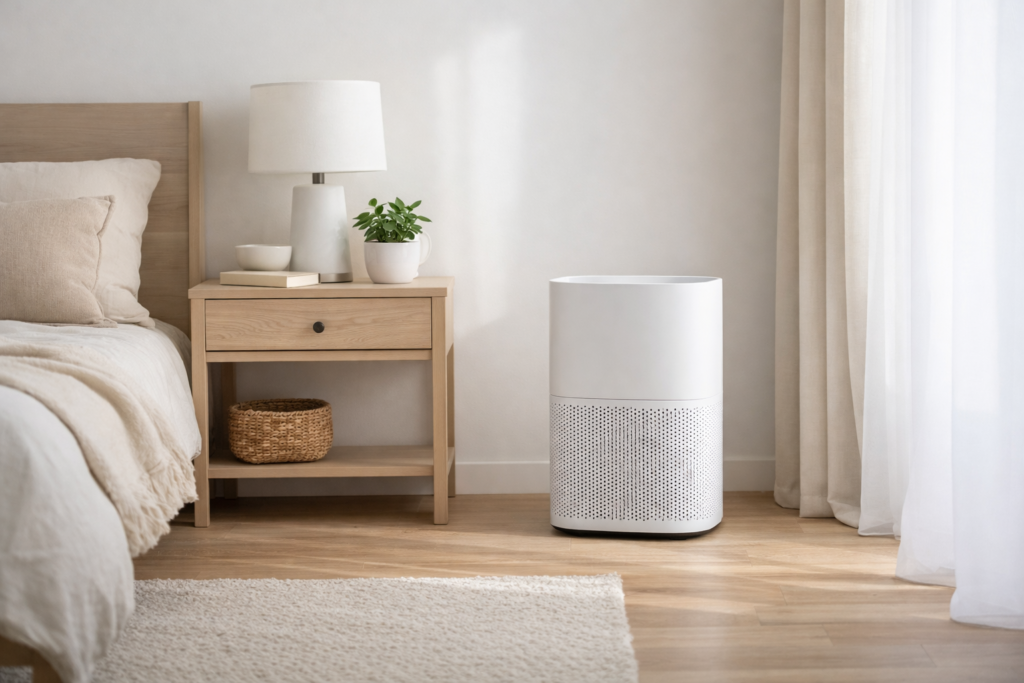
Shopping for air purifiers by room size sounds simple until you hit the packaging math. One model “covers” your living room, another claims it does twice that, and suddenly you are either overspending or under-buying and hoping for the best. This guide is for choosing confidently using one idea you can trust: how much clean air the unit actually delivers.
The short version
- Pick the room you care about most (usually bedroom or main living area), then size for that room, not the whole home.
- Use CADR as your anchor metric for particles. Higher CADR means faster particle removal.
- For typical 8-foot ceilings, a solid baseline is CADR at about two-thirds of the room’s square footage.
- If you want faster cleanup (allergies, wildfire smoke), size up. More CADR is rarely “wasted” if you can tolerate the noise.
- Ignore inflated “coverage area” claims that do not tell you CADR, fan speed, or assumptions.
Key takeaways
- CADR is measured in cubic feet per minute (cfm) of cleaned air and is meant to help you match an air cleaner to a room.
- Room size claims vary because brands assume different air-change targets. CADR lets you compare apples to apples.
- Decide on a clean-air goal (roughly 4 to 5 air changes per hour is a practical target for many homes, higher when you are trying to clear smoke or want faster results).
- Noise is the hidden limiter. A unit that is “big enough” but too loud to run is functionally too small.
- Two smaller units can beat one big unit if your space is divided (bedrooms, offices, closed doors).
Start here: air purifiers by room size come down to CADR and goals
You are making one decision: how much clean air you want delivered to your room, consistently. The factors that actually matter are (1) room volume (square feet and ceiling height), (2) CADR, (3) how many “clean air turnovers” you want per hour, (4) noise tolerance at the speed needed to hit your target, and (5) whether your space is open-plan or closed-off.
How to choose
1) CADR: the number that makes the rest easier
What it means
CADR (Clean Air Delivery Rate) is the amount of particle-cleaned air delivered per minute. It is used to size a portable air cleaner for a room.
Why it matters
Most marketing language is fuzzy. CADR is one of the few standardized signals that directly relates to how quickly a purifier can reduce particles in a given space.
How to evaluate it quickly
- Find the CADR (often listed for smoke, dust, and pollen). Smoke CADR is commonly treated as the most demanding particle size.
- Match CADR to your room area using a simple baseline:
- Baseline rule: CADR should be at least two-thirds of the room’s square footage (for 8-foot ceilings).
- If your ceilings are higher than 8 feet, size up.
Common mistakes or marketing traps
- Buying based on “covers up to 800 sq ft” without knowing the CADR or the assumptions behind that claim.
- Assuming “HEPA” automatically means fast cleaning. Filter type does not tell you air delivery speed.
- Ignoring that CADR is for particles. Gas and odor claims are a different conversation.
2) The plain-English CADR math (no spreadsheet required)
What it means
CADR is clean airflow. If you know your room’s volume and how many air changes per hour (ACH) you want, you can estimate the clean airflow needed.
Why it matters
This is how you avoid overbuying. You size for the result you want, not the biggest number on the box.
How to evaluate it quickly
- Compute your room area: length × width (sq ft).
- Estimate volume: area × ceiling height (ft).
- Pick a target ACH (how many times per hour you want the room’s air cleaned).
- Convert to airflow:
Target CADR (cfm) ≈ (Room area × Ceiling height × Target ACH) ÷ 60
For typical 8-foot ceilings, this becomes:
- 3 ACH: CADR ≈ room sq ft × 0.40
- 4 ACH: CADR ≈ room sq ft × 0.53
- 5 ACH: CADR ≈ room sq ft × 0.67
If you prefer a published shortcut, EPA provides a simple sizing chart (8-foot ceilings) that aligns with the two-thirds rule.
Common mistakes or marketing traps
- Forgetting ceiling height. A “big” bedroom with a vaulted ceiling needs more clean air than the floor plan suggests.
- Using the manufacturer’s “max coverage” as if it implies strong cleaning speed. It might assume a low ACH.
3) Use a sizing table to sanity-check your choice
Here is a practical sizing table based on EPA’s estimation chart for portable air cleaners (8-foot ceilings).
| Room area (sq ft) | Minimum CADR (cfm) | What this feels like |
|---|---|---|
| 100 | 65 | Small bedroom, nursery, office |
| 200 | 130 | Large bedroom, small living room |
| 300 | 195 | Medium living room, open bedroom suite |
| 400 | 260 | Large living room, open-plan section |
| 500 | 325 | Big open space, great room zone |
| 600 | 390 | Very large space or higher ceilings |
How to use this
- Treat this as a baseline for particle removal. If you want faster cleanup, choose higher CADR than the minimum.
- If you are dealing with wildfire smoke, AHAM notes a more aggressive rule of thumb: smoke CADR equal to room area (sq ft).
4) Noise and “usable speed” matter as much as CADR
What it means
Most CADR ratings are achieved at or near the highest fan speed. That is also where many purifiers become too loud for real life.
Why it matters
A purifier that is “correctly sized” but only tolerable on low speed will not hit the CADR you bought it for. The best-sized unit is the one you can run for long stretches, including while you sleep.
How to evaluate it quickly
- Look for a published noise rating in decibels, ideally by speed setting.
- Ask yourself where it will live:
- Bedroom: you will care about night noise.
- Office: you will care about call-friendly noise.
- Living room: you may tolerate higher noise for faster cleanup.
- Practical approach: if you are noise-sensitive, consider sizing up so you can run at a lower (quieter) speed and still get adequate clean air.
Common mistakes or marketing traps
- Buying the “minimum CADR” unit, then running it on low because high is annoying.
- Assuming “sleep mode” equals effective cleaning. Sleep mode often means reduced airflow.
5) Layout: open-plan spaces change the math
What it means
Air purifiers are room tools. Open floor plans blur what “the room” even is. EPA notes that for open floor plans, you should consider the entire space the unit will serve.
Why it matters
If your purifier sits in the living room but your kitchen and hallway are fully open, that one unit is now trying to influence a much larger volume.
How to evaluate it quickly
- If doors close: size each room separately.
- If doors do not close and air flows freely: size for the combined area or use multiple units to create coverage where you spend time.
- If the space is truly large: two units placed strategically often outperform one unit parked in a corner.
Common mistakes or marketing traps
- Sizing for the sofa area only when the air volume includes the kitchen and dining zone.
- Placing the unit behind furniture or curtains, blocking airflow.
Quick picks by scenario
- If you have a small bedroom (100–150 sq ft), prioritize CADR that clears the room quickly on a tolerable speed, avoid buying for the “whole home” when you only sleep in one room.
- If you have seasonal allergies, prioritize higher CADR than the minimum and consistent runtime, avoid choosing a unit so loud you only use it occasionally.
- If you have wildfire smoke exposure, prioritize smoke CADR and the ability to run at higher speeds, avoid “ionizing” or ozone-producing technologies.
- If you have a nursery or sensitive household, prioritize quiet operation at meaningful airflow and simple maintenance, avoid heavily scented “air freshening” add-ons that are not filtration.
- If you have pets, prioritize higher airflow and filter-change practicality, avoid under-sizing because hair and dander load filters faster.
- If you have an open-plan living space, prioritize either one high-CADR unit sized for the full area or two smaller units near where you actually sit, avoid trusting a coverage claim that assumes a low air-change target.
- If you work from a home office, prioritize steady mid-speed performance with low distraction noise, avoid choosing a “minimum CADR” unit that needs max speed to be useful.
What to ignore
- “Covers up to X sq ft” without stating CADR and assumptions.
- Overemphasis on “stages” instead of airflow and verified metrics.
- Vague claims like “removes 99.9% of everything” with no clarity on what that means in a room.
- Features that imply cleaning gases without meaningful carbon mass or clear performance data. (CADR is for particles.)
- Any purifier that intentionally produces ozone or uses ozone as a selling point.
A simple decision checklist
- What room am I sizing for (the room where we spend the most time)?
- What is the room area in square feet? What is the ceiling height?
- What CADR do I need for a baseline clean-air goal (start with EPA’s table or the two-thirds rule)?
- Do I want faster cleanup (allergies, smoke)? If yes, size up.
- Will I actually run it at the speed needed to hit that CADR?
- Is the space closed-off or open-plan, and does that change the effective “room” volume?
- Where will it sit so airflow is not blocked (not behind curtains, not tucked under furniture)?
- What is the replacement filter cost and cadence, and am I willing to keep up with it?
- If the room is large, would two units in two locations be more effective than one in the wrong spot?
FAQ
People also ask: What CADR do I need for a 12×12 room?
A 12×12 room is 144 sq ft. The two-thirds baseline suggests a smoke CADR around 96 cfm. If you want faster cleanup or you have higher ceilings, size up.
Is higher CADR always better?
Higher CADR generally means faster particle removal, but the tradeoffs are cost, size, and noise. The “best” CADR is the highest you can run comfortably for long stretches.
People also ask: How many air changes per hour should an air purifier provide?
There is not one universal number, but public health guidance often references aiming for about 5 or more air changes per hour of clean air when possible. For everyday home comfort, many people target a practical range and then adjust based on allergies, smoke, and noise tolerance.
People also ask: Should I run an air purifier on high all the time?
If the noise is fine, higher speed cleans faster. But many people do better with a “sustainable” setting: higher when the room is active (cooking, cleaning, high pollen days), lower at night. The key is consistent runtime.
Do I need one purifier per room?
If doors close, yes, you get the best results by treating each room as its own space. For open-plan areas, you may need to size for the full combined space or use multiple units. EPA notes multiple air cleaners can be considered if the area is larger than one unit can serve.
Can a portable air purifier replace ventilation?
No. Filtration helps reduce particles, but it does not remove all pollutants and does not replace source control and ventilation. Think of it as a strong supporting tool, not a substitute for fresh air when outdoor air is clean.
Do air purifiers remove odors and VOCs?
Some units include activated carbon or other media designed to reduce certain gases, but CADR does not rate gas removal, and performance varies. EPA notes there is no widely used performance rating system for portable air cleaners designed to remove gases.
Bottom line
Sizing is where most people either overpay or end up disappointed. Start with the room you care about, anchor on CADR, and pick a clean-air goal you will actually sustain. If you are dealing with smoke or want faster results, size up so you can get meaningful clean air without living on an unbearably loud fan setting. In most homes, the sensible default is “a little more CADR than the minimum,” chosen for real-life noise tolerance.